
Well into the harvest and two months into the soybean selling season, US Treasury Secretary Scott Bessent announced that “China is on track to keep every part of the deal” negotiated between Presidents Donald Trump and Xi Jinping in late October, which was intended to bring an end to nearly six months of paralysis for the American soybean market. According to a White House “fact-sheet” on the deal, which many have described as more of a “trade truce” in lieu of written commitment from Beijing, China will purchase at least 12 million metric tons of American soybeans “during the last two months of 2025”. By early December, China had purchased less than 20% of that. Contradicting the “facts” laid out by the White House, Bessent dug his heels in during a recent interview, claiming that China will fulfill its promise based on the original goal – but by the end of February.1
American soybean farmers’ patience is waning. Trump’s trade war with China and bailout of Argentina left American farmers feeling betrayed by a president who promised “America first”. Yet, the new administration’s policies within Trump’s first year back in office show the only interest he is putting first is his own.
Trade War and the American Soybean Crisis
Soybean farmers are still reeling from Trump’s first presidential term. China’s response to Trump’s first trade war led the value of American soybean exports to drop to $3.1 billion in 2018 from $14 billion in 2016, when China made up 60% of soybean exports.2 Soybean exports are now only a fraction of that since the start of Trump’s latest trade war which began earlier this spring.
American soybean exports to China since then have declined. After being hit with high tariffs in 2016, Beijing has sought to diversify its soy imports, with Brazil now taking over as their largest exporter. Nonetheless, the Chinese market still comprises Americans’ largest portion of soy exports, at 54% in market year 2023/24. The second largest purchaser is the EU trailing far behind – at only 11%.3 In response to Trump’s tariffs implemented earlier this year, China enacted 20% retaliator tariffs on the US, making American commodities like soybeans more expensive and even harder to compete with the already cheaper South American alternatives.4 Beijing effectively boycotted American soybeans for months, with farmers rapidly losing their prime window to sell to China the longer the trade war dragged on.
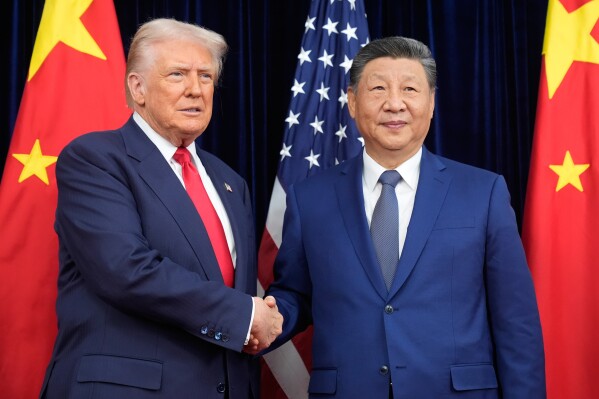
Since Brazil surpassed soy exports to China, the US’ prime selling window to sell soybeans is between September to February due to seasonal differences with South America.5 Farmers finally thought they would have some respite when Trump announced the long-awaited talks with Jinping as “12/10”. The talks culminated into a trade truce, far from a stable agreement that would instill confidence in the market. The White House originally stated that China agreed to purchase 12 million metric tons of American soybeans by the end of 2025 and 25 million metric tons over the next three years. Joe Vaclavik, founder of Standard Grain and host of the Grain Markets and Other Stuff podcast described the announcement as “underwhelming”.6
The trade truce reduced tariffs from 57% to 47% by reducing tariffs on fentanyl by 10%. However, American soybean prices are still uncompetitive in the global marketplace. There is also no written commitment between the two countries, raising concerns that tariffs can easily be reenacted if there is renewed tension between Washington and Beijing. China is already late in fulfilling its promise, which the US administration has accommodated by moving the goal post. High tariffs also remain in place despite the truce.7 Fair to say, the move has not instilled the confidence needed to bring stability and assurance to American farmers, the producers of the US’ largest agricultural commodity export.
Farmers have a right to be skeptical about the truce and whether this administration really has their back after failed campaign promises for one of their largest voting blocs that helped win them the election. Not only have they missed their prime selling season, but tariffs have increased their price of production, forcing many to dig deeper in debt, disproportionately affecting smaller and younger farmers. Bankruptcies among farmers in the US have already spiked by about 50% from 2024.8
Amid this crisis facing soybean farmers, Trump bailed out Milei’s Argentina, who in turn lifted their export taxes, allowing China to fill the gap in soybean purchases at the expense of American farmers.
“Make Argentina Great Again”
While the American soybean industry is collapsing, Trump decided to bailout Argentina, led by his fellow far-right ally, Javier Milei. In October, the administration announced a $20 billion currency swap with Argentina to slow down the country’s economic downturn and build up their reserves which the Milei government has depleted in its attempts to stabilize the peso by de-valuing it. The move came weeks before the country’s midterm elections, seen as a referendum on President Milei’s government and free market agenda. Milei’s party’s poor performance during the September provincial elections in the capital Buenos Aires, where Argentines pelted Milei’s car, appeared to be a potential precursor to the midterm elections. Without a drastic intervention, Trump may have lost an important ally who reinforced everything from anti-wokeism and skepticism of the climate crisis and public health9 to his economic policies, much of which appears to have been influenced by the new far-right Argentine government. Milei ran on a platform of austerity promising to bring an end to Argentina’s chronic debt and hyper-inflation by slashing government spending with his metaphorical chainsaw. Sound familiar?

Milei was the first foreign leader to visit the then-president-elect Trump in November 2024 and even attended his inauguration the following year. He is credited with inspiring Musk’s DOGE program, equipping him the billionaire with his own chainsaw to not-so-figuratively cut what he perceived as waste and bureaucracy. However, as the New York Times states, Milei’s supposed influence over the Trump administration’s economic policies, “begs the question why the U.S., the world’s leading economy, is borrowing government reform techniques from Argentina, a nine-time serial defaulter and 100-year economic laggard”.10
So what exactly has Milei accomplished? Since his election in 2023, annual inflation has dropped from 200% to historic lows of 43.5% by mid-year 202511 through drastic fiscal austerity measures including halving government departments, firing thousands of public sector employees, reforming the country’s pension program, and slashing utility and transportation subsidies. Argentina’s inflation, debt, and spending has been out of control for decades, and Milei remains popular among many Argentines for shifting the economic tides.
However, Milei’s political opponents have claimed the average Argentine is paying the price for Milei’s fiscal policies, not the political “caste”, or political elites which he promised would bear the brunt of his reforms during his campaign. Unemployment has risen from 5.7% to 6.9% and nearly 32% of Argentines remain in poverty. The cost of bus and train tickets have more than doubled. Middle-class families have been slapped with upwards of 115% increase in power-bills. Argentines feel that he has become the very political caste he decried on the campaign trail and that he is simply out of touch.12
During an interview with a BBC journalist, Milei rejected the notion that the Argentine people were struggling, though he could provide the price of a liter of milk. The interview went viral for exposing how disconnected the president appeared to be, casting parallels with Trump who has repeatedly claimed that grocery prices are “way down”, contravening reality and struggles of the average American household.13 Against this backdrop, Argentines punished Milei’s party during their September provincial elections, raising doubts on popular support for his economic reform. Afraid of the fall of a similarly-minded populist, anti-woke government and prospective end of Milei’s free market agenda, the White House swooped in with their promise of a $20 billion bailout (which subsequently was increased to $40 billion with a planned additional $20 billion in loans or investments through private banks and sovereign wealth funds)14, if Milei’s party maintained their majority after the October midterm elections, a clear attempt at influencing electoral outcomes which under any other administration would have been criticized as electoral interference.
Leaked messages from Treasury Secretary Scott Bessent shows how Argentina returned the favor: “We bailed out Argentina, and in return the Argentines removed their export tariffs on grains, reducing their price, and sold a bunch of soybeans to China at a time when we would be selling a bunch of soybeans to China”. Only days after a posh gala in New York City where secretary Bessent praised Milei for his efforts to “make Argentina great again” and leadership for “recogni[zing] that government is not the solution, it is the problem”15, Milei dropped the country’s export taxes on commodities. Having effectively boycotted the purchase of US soybeans in retaliation for Trump’s astronomical tariffs, Beijing naturally moved to immediately purchase Argentine soybeans – four million bushels, or 20 shiploads in the span of two-days.16
Several Republican lawmakers took to X to call out both the American and Argentine administrations, including Senator Chuck Grassley of Iowa:
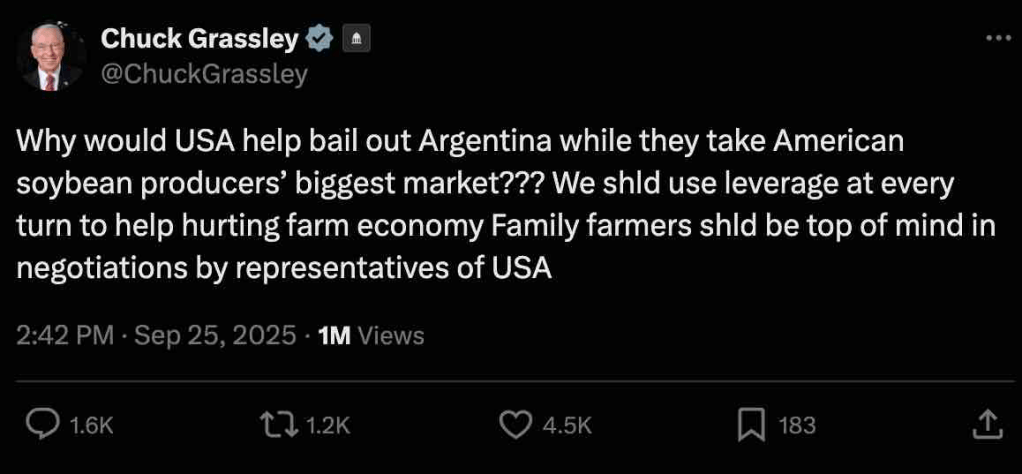
Joe Vaclavik on Grain Markets was more explicit: “Farmers are in a really tough spot right now, so I think this administration needs to get its head out of its ass and help its constituency here”.17
Instead, Trump has only doubled-down.
Rib-eye or Picanha?
Despite grocery store prices supposedly “way down” since Trump took office, the president has called on American cattle ranchers to lower their prices. But it isn’t as simple as that. Demand for beef, despite the rise of vegetarian diets and general health-conscious efforts to reduce consumption of red meats, has remained high. The supply, however, has declined over the decades. Cattle ranches have dropped by nearly a fifth since 2017, with cattle overall at its lowest in 75 years. Instead of tackling some of the roots of the issue keeping price of beef high, notwithstanding high operational costs (exacerbated by the tariffs) and monopoly of meat processors (four companies dominate the market, squeezing out small ranchers and accused of scheming to inflate costs), Trump proposed quadrupling beef imports from none other than Argentina.
Higher prices for beef were keeping small cattle ranches afloat. Now ranchers are worried that increased imports will not only undercut their already slim profits, but won’t reduce retail prices the way the administration and USDA claim it will.
“Bottom line: if the goal is addressing beef prices at the grocery store, this isn’t the way. Right now, government intervention in the beef market will hurt our cattle ranchers. The U.S. has safe, reliable beef, and it is the one bright spot in our struggling ag economy. Nebraska’s ranchers cannot afford to have the rug pulled out from under them when they’re just getting ahead or simply breaking even. I strongly encourage the Trump administration to focus on trade deals that benefit our ag producers—not imports that will do more harm than good.”
– Senator Deb Fischer of Nebraska
In addition to Senator Fischer, the proposal drew rare criticism from Republican lawmakers representing beef-producing states. Eight Republican congressmen sent a letter to the White House asking for clarity on the increased foreign imports and expressing their concern over the decision.
Unmoved, Trump has remained characteristically steadfast with his decision, and even took to Truth Social to dismiss cattle ranchers’ – another major GOP voting bloc- concerns, claiming that the “only reason” that the industry has begun to bounce back after decades is because of tariffs lobbed on cattle imports. In reality, the higher retail prices have helped the industry. Tariffs, on the contrary, coupled with ICE deportations of agricultural workers, have only contributed to increased production costs.18 On November 21, Tyson Foods, the US largest meat supplier announced the closure of one of its major beef plants in Lexington, Nebraska, which will leave over 3,200 unemployed – nearly a third of the town’s population. Tyson will also scale back its operations in Amarillo, Texas, wiping out 1,700 jobs there. The move, which is estimated to reduce nationwide beef production between 7-9%19, comes a week after the White House’s announcement that it will rollback tariffs on certain goods, including beef. Between tariffs on farmers’ supplies and the reversal of tariffs and increase on beef imports, cattle ranchers have little incentive to fill the cattle supply shortage by producing more for less.
The US already has an imbalanced trade relationship with Argentina, the National Cattlemen Beef’s Association points out in a statement on Trump’s proposal. Over $801 million of beef is imported to the US compared to only $7 million exports of American beef to Argentina over the past five years. Combined with the $40 billion bailout to Milei’s government and moving to fill the gap in US soybean exports to China, importing even more Argentine beef just deepens American farmers and cattle ranchers’ sense of betrayal. It begs the question, what happened to America first?
The Perennial Soybean Dilemma
That brings us back to soybeans. Even if China were to fulfill its promise to purchase the remaining soybeans by the end of December 2025 February 2026, the long-term economic outlook for soybean farmers is still grim. While less prohibitive than before the trade truce, Beijing’s 10% tariffs still leave American soybeans less competitively priced than Argentina and Brazil, China’s other main soybean importers. Unless major diplomatic ties are forged between Beijing and Washington, the former is unlikely to be incentivized to continue purchasing soybeans at the rates needed to sustain the American soy market.
The crisis facing American soybean farmers is protracted and cannot all be chalked to the current US presidency. For decades, the whims of different administrations – Republican and Democratic alike – have deepened farmers’ financial stress and hindered their ability to adequately prepare to weather the next political storm.
A significant departure in the form of long-term reform is not only critical for bringing stability to the soybean market, but essential for the survival of farmers. Breaking up the monopoly of food manufactures, many argue, is one step that can widen the market space for nascent and smaller farms who have been entrapped by the exploitative practices of larger conglomerates. Another is incentivizing farmers to move away from export-dependent monocrops and grow crops that can be sold domestically.20 Whether the new administration will prioritize small farmers over billionaires – or rural America over Argentina, for that matter, remains unseen.
In the meantime, the figurative chainsaw gifted by Milei has slashed billions in foreign aid, one of the few reliable markets for American farmers, further disrupting the US agricultural supply chain21 under the guise of prioritizing American interest over global ones. Yet, the new administration appears to have made an exception for Argentina. The administration’s $40 billion bailout helped secure a political victory for Milei’s party during the October midterm elections. Trump has promised a fraction of that amount for a plan to bailout farmers from the “hundreds of billions of dollars” in purported tariff revenue.22 While the plan, if executed, may provide a immediate relief to some, it falls far short of the reform and stability needed to keep farmers afloat in the long-term and through the next trade war.
*Update (12/9): This post initially did not reference the $12 billion bailout plan promised to farmers by President Trump on December 8, a day after the post was published. The conclusion has been updated to reflect the announcement, though it’s important to note that this has not been the first time the White House has promised a bailout for farmers.
- https://podcasts.apple.com/us/podcast/scott-bessent-thinks-youre-dumb-lies-about-china-soybean/id1494161095?i=1000739667041 ↩︎
- https://www.politico.com/news/2025/09/28/soybeans-sacrificed-in-trumps-china-gamble-00583232 ↩︎
- https://soygrowers.com/news-releases/soybeans-without-a-buyer-the-export-gap-hurting-u-s-farms/ ↩︎
- https://www.aljazeera.com/gallery/2025/10/14/us-soya-bean-farmers-battered-by-trade-dispute-with-china ↩︎
- https://soygrowers.com/news-releases/soybeans-without-a-buyer-the-export-gap-hurting-u-s-farms/ ↩︎
- https://podcasts.apple.com/us/podcast/dont-call-it-a-trade-deal-soybean-prices-fall/id1494161095?i=1000734197338 ↩︎
- https://podcasts.apple.com/us/podcast/dont-call-it-a-trade-deal-soybean-prices-fall/id1494161095?i=1000734197338 & https://podcasts.apple.com/us/podcast/soybean-prices-tank-because-china-isnt-buying-enough/id1494161095?i=1000735706764 ↩︎
- https://www.aljazeera.com/gallery/2025/10/14/us-soya-bean-farmers-battered-by-trade-dispute-with-china ↩︎
- https://www.wola.org/analysis/three-ways-that-argentinas-milei-is-trumps-doppelganger/ ↩︎
- https://www.nytimes.com/2025/03/03/opinion/trump-milei-musk-argentina.html ↩︎
- https://www.reuters.com/world/americas/argentina-inflation-cools-may-lowest-over-five-years-2025-06-12/ ↩︎
- https://www.nytimes.com/2025/03/03/opinion/trump-milei-musk-argentina.html & https://buenosairesherald.com/politics/buenos-aires-public-transport-fare-hike-takes-effect-today ↩︎
- https://www.cnn.com/2025/10/24/politics/fact-check-grocery-prices-trump ↩︎
- https://www.newyorker.com/news/the-financial-page/donald-trumps-forty-billion-dollar-exception-to-america-first ↩︎
- https://www.batimes.com.ar/news/world/us-treasury-secretary-scott-bessent-lauds-milei-at-midtown-gala-as-us-plans-argentina-rescue.phtml ↩︎
- https://podcasts.apple.com/us/podcast/us-treasury-secretary-make-argentina-great-again/id1494161095?i=1000728383790 ↩︎
- https://podcasts.apple.com/us/podcast/us-treasury-secretary-make-argentina-great-again/id1494161095?i=1000728383790 ↩︎
- https://newrepublic.com/article/201461/trump-tariffs-soybean-industry-china-reckoning ↩︎
- https://apnews.com/article/beef-prices-tyson-plant-closing-a47113754d3a2962970481153657a02f ↩︎
- https://prospect.org/2025/10/16/2025-10-16-amercia-farming-soybean-monoculture-bailouts/ ↩︎
- https://www.devex.com/news/us-farmers-about-to-become-roadkill-under-trump-food-aid-cuts-senators-warn-110293 ↩︎
- https://abcnews.go.com/Politics/trump-announce-12-billion-bailout-plan-farmers-white/story?id=128214384 ↩︎
 Politics & Pomegranates
Leave a comment