
Like many things American, beef has a racist past. From the belief that beef fueled Western advancement and imperialism, to the deliberate campaign to replace bison with cattle on Indigenous land, and vilifying immigrant populations that did not rely on a bread-and-beef diet, beef, a quintessential component of the American identity, has a complicated history.
Culinary Determinism
Food historian Rachel Laudan describes the feigned theory that American and European consumption of beef contributed to Western population growth and global power in the 19th century as “culinary determinism”. With limited nutritional science at the time, experts believed that American and Europeans’ hearty diet of bread and beef empowered them to expand their political and economic influence across the Eastern world. The U.S. and Europe relied on this pseudoscience to project an image of superiority over other populations to justify their exploitation and expansion. Following this logic, countries threatened by – or envious of Western imperialism – believed they could strengthen their own nations and compete with the West by incorporating more bread and beef into their own national cuisines. To resist Western influence and Anglo expansion, these countries -including Japan, China, India, Brazil, Italy, Mexico, among others – sought to westernize their own food.1
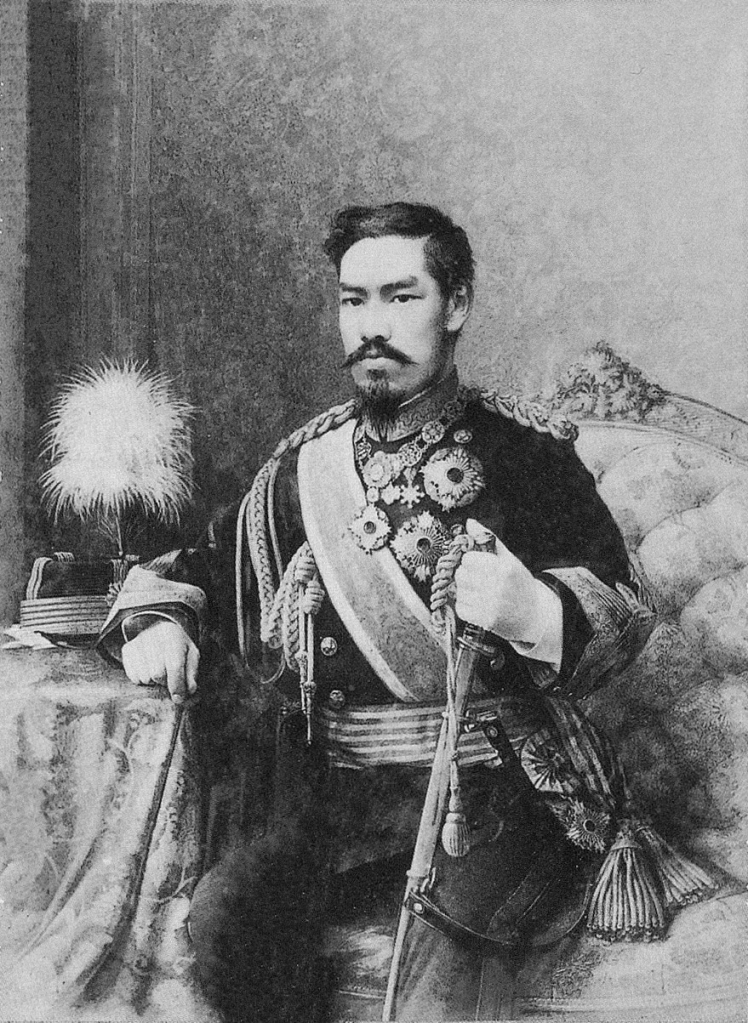
After establishing formal diplomatic relations with the U.S., France, and the U.K in 1858, the Meiji government eventually lifted the meat-eating ban which had been in effect since 675 through a sudden announcement that the Emperor himself had eaten beef. In the years that followed, the government promoted beef-eating (and Western diet, in general) by publishing booklets on how to prepare beef. While Emperor Tenmu banned meat consumption in 675 to enforce religious purification in line with Buddhist principles that discouraged violence, and by extension, killing animals and eating their flesh, beef-eating emerged as a civic duty during the Meiji Period. Under the slogan, “Enrich the country, strengthen the army”, emulating Western diet was portrayed as critical for developing strong bodies like those of Americans and Europeans, and keeping up with the West’s global dominance.2 While beef-eating was a method for expanding power and influence abroad, within the U.S., it was weaponized to discriminate against certain communities and impose beef as central to the American identity.
Meat vs. Rice and Chinese Exclusion
On May 6, 1882, President Chester A. Arthur passed the Chinese Exclusion Act that, for the first time in American history, singled out a race by banning immigration of Chinese laborers into the U.S. and prohibited Chinese immigrants from becoming naturalized citizens. The bill claimed that Chinese were physically and socially unfit to be laborers, and that their cultural values were antithetical to being American. Chinese were criticized for refusing to conform to so-called American values, which included adopting a bread-and-beef diet. Their rice-based diet was perceived as being inferior and un-American. As described in a pamphlet published by the American Federation of Labor, “Some Reasons for Chinese Exclusion: Meat vs. Rice, American Manhood against Asiatic Coolieism” in 1902, to call for its extension:
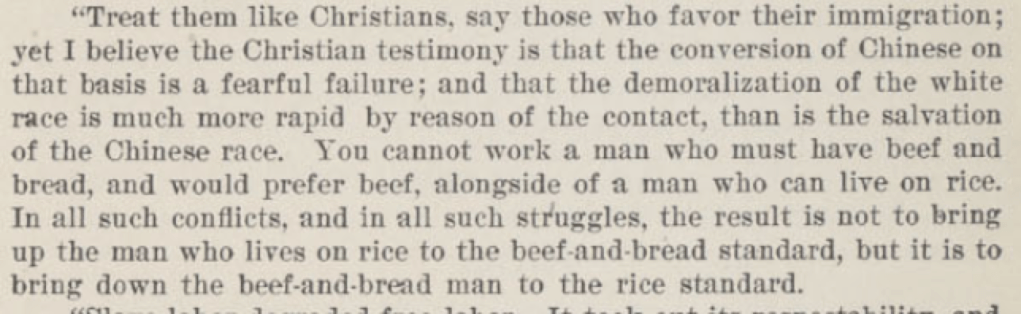
The very title of the pamphlet shows the battle lines drawn between meat-eating, which was associated with a masculine American identity, and rice-eating, with the racial epithet given for indentured laborers who were seen as a sub-class.3 Indeed, in 1902 president Theodore Roosevelt continued to pedal the racist rhetoric against Chinese laborers as inferior to others:
“The conditions in China are such that the entire Chinese coolie class, that is, the class of Chinese laborers, skilled and unskilled, legitimately come under the head of undesirable immigrants to this country, because of their numbers, the low wages for which they work, and their low standard of living. Not only is it to the interest of this country to keep them out, but the Chinese authorities do not desire that they should be admitted.”
It would take 60 years before the Chinese Exclusion Act was eventually repealed in the U.S. Concerted campaigns against the act helped redefine who “we the people” constitute and pave the foundation for defending equal rights not only for Chinese, but all those that do not fit the white nativist image of a beef-eating American.4 As we will continue to explore in this blog, this would not be the last time that beef-eating, and other cultural perceptions of the “American diet”, would be used as a measuring stick for assimilation of immigrant communities.
Beef over Bison
Beef as a central marker to American identity, or at least the white purist’s image of it, can be traced back to the early days of settler colonialism. As Hannah Cutting-Jones, Assistant Director of Food Studies at University of Oregon describes, the U.S.’s “burgeoning national identity and westward expansion to the settlement and acquisition of cattle-ranching lands. Until 1848, Arizona, California, Texas, Nevada, Utah, western Colorado and New Mexico were part of Mexico and inhabited by numerous tribes, Indigenous cowboys and Mexican ranchers.”5
Cattle ranches required large swaths of land, much of which was seized by the U.S. government from Indigenous people, ultimately forcing their mass displacement and leading to lasting food insecurity for these communities. The population of bison, a vital resource for Indigenous people not only for its meat, but also for creating tools and clothes out of every part of the animal, was already in decline by the late 18th century. However, in the 1800s, the U.S. Army expedited their near extinction by encouraging bison hunters and even troops to not only kill bison for food, but also for target practice. Aside from complete disregard for indigenous populations whose lands they pillaged, the U.S. also saw this as an opportunity to weaken Indigenous nations who relied on bisons. With “no bison, little game, and inadequate or non-existent government food supplies”, these nations suffered from malnutrition and hunger.6 Indigenous people would not be allowed to benefit from the prospering beef industry, despite the cattle ranches built on their own stolen land.
The government now controlled their livelihoods, which they limited to crop-based agriculture. Settlers also seized their farmland, cutting indigenous people from their primary food sources and forcing displacement. As Andrew Freeman depicts in her highly accoladed Ruin their Crops on the Ground, George Washington ordered his troops to do just that – destroy their crops to force subservience, establish dominance, and seize their land. In 1830, president Andrew Jackson introduced the Indian Removal Act, which displaced between 70,000 to 80,000 Indigenous to “Indian territory”, land that was often barren and uncultivable, forcing them to rely on government rations. The journey to these lands would become known as the “Trail of Tears”, where 4,000 from the Cherokee Nation died alone. 7
The impact of the forced displacement off land which provided sustenance and independence for Indigenous populations into reservations cemented inequality for generations.
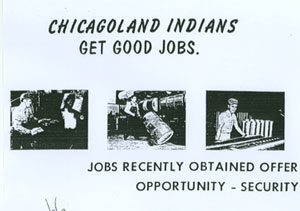
In the 20th century, the government sought to force indigenous population’s assimilation through the 1952 “Voluntary Relocation Program Act”, that paid for indigenous people living in reservations to move to cities under the guise of well-paying jobs, that ultimately did not materialize to the extent it was advertised. Indigenous people not only continued to live in poverty in these cities as they had in their reservations, but they also faced a cultural shock and racism. For many, returning home was not an option as the government had terminated and converted reservations into private developments. By 1968, while the government had stopped terminating tribes, the damage had already been done. Over a million acres taken through the program and sovereignty stripped from over a hundred tribes were never restored.8 The “tragic plight”, as President Lynson Johnson called it in a letter to Congress, had contributed to 40% unemployment (more than ten times the national average), and an average lifespan of 44 years (over 20 years under the national average).
“The American Indian, once proud and free, is torn now between white and tribal values; between the politics and language of the white man and his own historic culture. His problems, sharpened by years of defeat and exploitation, neglect and inadequate effort, will take many years to overcome.”
Beef has a complicated, and at times, racist past. Today, we wrestle with eating beef with concerns over climate change and our own personal health. Beef consumption in the U.S. is on the decline due to a myriad of factors, yet its racist roots in the U.S. is not one of them. Health and environmental concerns aside, there is nothing wrong with eating beef, and you surely are not a racist if you do. But using it to project an image of superiority over others and even promote its consumption at the expense of others cannot be reconciled. Looking back at our past will, hopefully, help us avoid repeating the same mistakes and recognize the challenges that foreign, immigrant, and indigenous communities faced as a result of the U.S.’s racist past.
- Rachel Laudan. Cuisine & Empire: Cooking in World History. 2013. ↩︎
- Plenus “kome” Academy. Meat Eating in Modern Japan. https://www.plenus.co.jp/kome-academy/en/roots/meat.html ↩︎
- https://www.npr.org/sections/codeswitch/2013/11/25/247166284/a-history-of-indentured-labor-gives-coolie-its-sting ↩︎
- https://www.pbs.org/wgbh/americanexperience/films/chinese-exclusion-act/ ↩︎
- https://www.salon.com/2024/10/28/how-beef-became-a-marker-of-american-identity_partner/ ↩︎
- https://egc.yale.edu/sites/default/files/2021-04/2021-0423%20EconHistory%20Conference/bison_short_FGJ_april_2021%20ada-ns.pdf ↩︎
- Andrew Freeman. Ruin Their Crops on the Ground: The Politics of Food in the United States, From the Trail of Tears to School Lunch. 2024. ↩︎
- https://www.apmreports.org/episode/2019/11/01/uprooted-the-1950s-plan-to-erase-indian-country ↩︎






Leave a Reply