
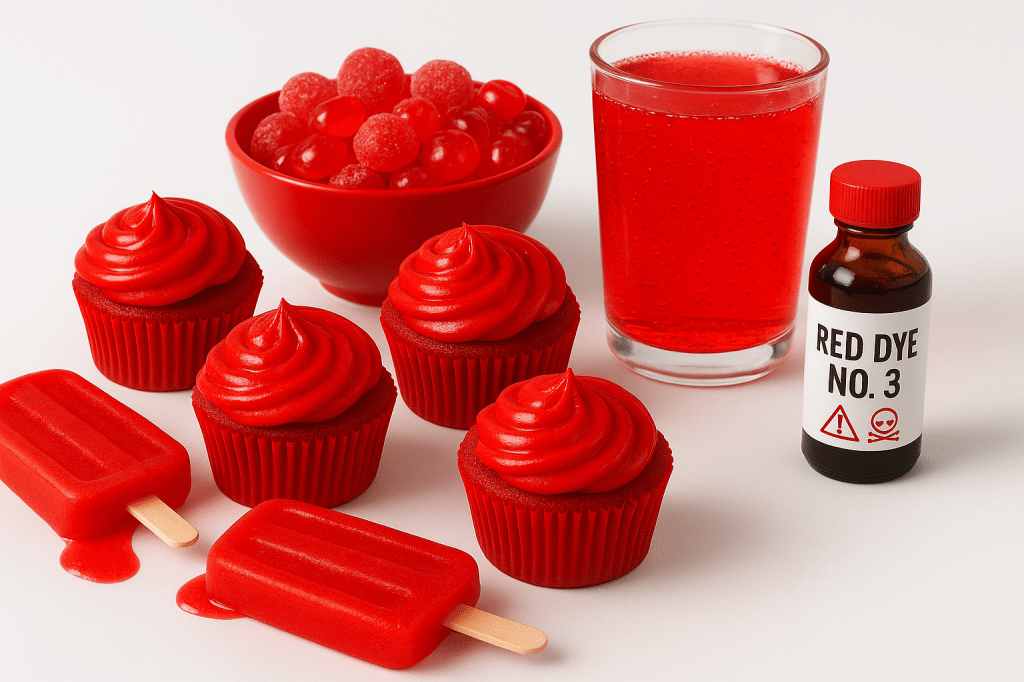
These days, there are few issues that Republicans and Democrats seem to agree on, from national holidays, school curriculum, electoral administration, to foreign assistance. However, one unexpected common enemy that has united both parties is synthetic food dyes. After 35 years of unbridled use in coloring drinks, desserts, processed foods, and even medication – Red Dye No. 3 has finally been banned. The FDA banned Red Dye No. 3 on January 15 in response to a long campaign against artificial food coloring by a coalition of health organizations and relatively minimal resistance from the food industry.1 Legally, the ban is long overdue since it was linked with cancer in the 1980s, but, at the time, the government appeared reluctant to butt heads with powerful food industry and dragged its feet for decades. The battle waged against artificial coloring has emerged as a bipartisan issue, with both Republican and Democrat-run states and municipalities pursuing legislation to place restrictions on the most toxic of dyes in lieu of stronger federal action. Texas2 and New York City3 are just some of the most recent examples. Combined with California4, which outright banned Red Dye No. 3 in 2023, the three represent some of the country’s most populous centers, comprising nearly a quarter of the entire American population.
The rise of the “Make America Health Again” movement led by Robert F. Kennedy (who gained his notoriety as a bear-killing anti-vaxxer conspirator who cashed in political favors to secure his appointment as Secretary of Health and Human Services under the Trump administration), has eased Republicans into throwing their weight behind some public health initiatives again. Reading the tea leaves, the food industry is finally relenting in its decades-long food fight to preserve artificial coloring.
Red Dye No. 3, AKA FD&C Red 3 and E127 on food labels, is a petroleum-based artificial dye used to color anything from cereals, cupcakes, halloween candy, ice cream, sodas, sports drinks, sausage, among other popular food products and consumables. Food dye has been a popular marketing ploy to appeal to our deepest emotional connections with food. Color has tremendous influence over our perception of food, with vivid red triggering strong reactions in particular. Aside from appealing to our primal carnal appetite for its association with blood, which by extension signals meat to the brain, it is also associated with the ripeness of fruits and vegetables, such as apples and tomatoes.5 We are mentally wired to think of sweetness when we see that vivid cherry red, which is why the food industry has slyly incorporated it into sugared goods.
Like most things artificial, not to mention petroleum-based, studies have linked synthetic dyes with harmful health effects. Decades ago, studies found potential links between Red Dye No. 3 and cancer.6 More recent studies have also shown links with behavioral issues including ADHD, particularly among children.7 So if red dye is unsafe for consumption, how has the food industry been allowed to use it for so long?
Following the Food Additives Amendment and Color Additives Amendment passed respectively in 1958 and 1960, which require industries to scientifically test the safety of food products and clearance by the FDA, the cosmetic industry petitioned to use Red No. 3. The FDA denied its petition after a test revealed a higher increase in thyroid cancer among rodents exposed to the dye. According to the Delaney Clause, if studies show that commodities have a carcinogenic potential linked with animals, then it is deemed unfit for ingestion and thus prohibited, even if no direct link with humans has been established.8 Therefore, the government is legally obligated to also extend its ban to ingestions, i.e. food and drugs. But it took the FDA 35 years to finally enforce it. The language of the FDA’s notice of the ban strikes a begrudging tone by emphasizing how “…claims that the use of FD&C Red No. 3 in food and in ingested drugs puts people at risk are not supported by the available scientific information,” and suggesting that it was compelled to issue the ban due to a petition led by the Center for Science in the Public Interest (CSPI) the Delaney Act.9 The notice goes on to say that the dye is not used widely in food compared to other food coloring.
When Vox Media reached out to the FDA to ask why it had taken them so long to ban the dye, it referred them back to the notice, emphasizing that there are no established carcinogenic links with humans. But what about other health risks?
In 2021, Californian Governor Gavin Newsom banned artificial dyes in schools following a health assessment which found behavioral issues associated with consuming food dyes, including “inattentiveness, hyperactivity, and restlessness in sensitive children.”10 This similar issue drove West Virginian Republican lawmaker Adam Burkhammer to introduce a bill in the state legislature to ban food coloring in schools, which passed with broad bipartisan support and is now in effect and will be extended to the rest of the state next year. Representative Burkhammer saw firsthand the harmful effect of food coloring with his own son’s behavior, and the improvement in his ability to focus and attention span after he stopped consuming dyed food.11 According to an interactive map created by the Environmental Working Group, 23 states are pursuing legislation regulating the use of harmful food chemicals, including preservatives and artificial food coloring. Several of these are Republican-run states, including Virginia, Oklahoma, Florida, Minnesota, and Arkansas.
While it feels like most issues have become polarized today, the battle against food dye has surprisingly skirted by with the support of both parties. This can be partly attributed to RFK’s MAHA movement, which is hard to take seriously considering his beliefs against vaccines which even drew criticism from House Speaker Mitch McConnell, a childhood survivor of polio, who was the sole Republican to vote against Kennedy’s nomination. Nonetheless, the movement enabled Republicans to support some public health issues without having their loyalty to small government and deregulation questioned. The names of various legislation in Republican states often pay tribute to the MAHA movement, such as Arkansas SB9’s “To Create and Make Arkansas Healthy Again Act” and Texas’ SB25’s “Make America Healthy Act”. In September, Republicans sponsored multiple bills, which will likely garner bipartisan support in the Democrat-dominated Massachusetts legislature to ban the use of certain food dyes from being sold or provided in public schools.12 The list goes on and is rapidly growing.
What is the future of artificial coloring in American-produced food? The FDA’s ban of Red Dye No. 3 is undoubtedly a positive development, but federal enforcement continues to fall short on what is needed to protect Americans’ health from harmful chemicals and remains largely voluntary. In April, RFK announced that he had reached an “understanding” with major food manufacturers on phasing out petroleum-based food dyes by 2026. As a long-time foe of food coloring, RFK disparaged the industry by stating that “If they want to add petroleum, they want to eat petroleum, they ought to add it themselves at home. They shouldn’t be feeding it to the rest of us, and without our knowledge or consent.”13
The FDA’s website states it seeks to eliminate Green No. 3, Red No. 40, Yellow No. 5 and 6, and Blue No. 1 and 2 from the national food supply by the end of 2027 and is actively working on targeting Orange B and Citrus Red 2 next. Some major food manufactures have made “commitments” to eliminate the use of food coloring, including Mars, Hershey, J.M. Smucker, Nestle, General Mills, Kraft Heinz, Sam’s Club, Tyson’s Food, Kellogs, PepsiCo, Coca Cola, Campbell’s, among others.14
This informal agreement, or voluntary self-enforcement at best, has been criticized by groups like the CSPI for not going far enough. Nonetheless, the food industry has started exploring, and in some cases, already swapped artificial dyes with natural food coloring even before MAHA. In 2015, Kraft announced that it would no longer use synthetic coloring to achieve its signature bright orange color in its macaroni and cheese that we all grew up with. The conglomerate swapped Yellow No. 5 and 6 with paprika, annatto, and turmeric. As this Reddit post is aptly titled, “Kraft changed its mac & cheese recipe and nobody noticed.” I surely didn’t. Major restaurant chains are also following suit. In May, In & Out announced it would also phase our artificial dyes such as Red Dye no. 40, high fructose corn syrup, and a range of preservatives from its menu. According to the FDA, it has already “completed” its commitment by removing the red coloring from its strawberry milkshakes and pink lemonade.
My former coworker once mused about what cancer levels will look like for our generation considering the amount of preservatives and harmful chemicals we consume without knowing it, as a consequence of the nascent nutritional research and lack of public awareness and deregulation. That tangential thought drove me to stop microwaving food in plastic Tupperware, and more recently, stop using food coloring when cooking. But how will I achieve that rich red color when baking one of my favorite desserts – red velvet cake? With tomato juice?
Implementing natural food colorings is not straightforward. Americans have become used to associating bright colors with certain flavors, so despite the harmful effects of consuming dye, some may not eagerly welcome the paler, duller colors from natural foods – at first. Similarly, it can take time to source the right fantastical colors to reach those bright hues to effectively replace synthetic food dyes. It also requires adjusting recipes to accommodate the natural sweetness provided by fruits among other flavors.
Natural food coloring is complicated. Growing certain species of fruit, vegetables, and spices that produce the vibrancy needed to color food parallel with artificial dyes takes time. It could also take ten times the amount of coloring from natural food to reach the same vibrancy from artificial dyes.15 I struggled with this recently when making my mom’s recipe for pandan cake. I doubled the amount of pandan leaves that the recipe called for to avoid using the prescribed one drop of green dye, then tripled it – but still struggled with getting that satisfying bright lime colored green. I eventually rifled through my soap-making supplies to find some green dye, convincing myself that one drop wouldn’t kill me. After doing the research for this post though, I may think twice next time, and come to terms with the pale, yet natural color of the cake.
We are hard wired to like vibrant colors that artificial dyes provide. Afterall, we are products of marketing tactics that leverage our emotional connections with colors. But just as we can emote bright colors with sweetness and satisfaction, we can rewire ourselves to associate more natural coloring with health and positivity. For some foods, like our beloved childhood mac and cheese, we may not even notice the difference.
Bipartisan efforts to reform the multi-billion-dollar food manufacturing sector reflect a rare political consensus on public health. While advancing legislation under the banner of “MAHA” may irk Democrats, the outcome is worth celebrating. In divided societies around the world, non-polarizing issues are often used as low-hanging fruit to bring opposing political parties together and build common ground. The elimination of toxic food coloring may feel inconsequential compared to the myriad of existential problems facing the U.S. today, but these small efforts can plant the seeds for future bipartisan efforts to advance the public good.
- https://www.fda.gov/food/hfp-constituent-updates/fda-revoke-authorization-use-red-no-3-food-and-ingested-drugs ↩︎
- https://thehill.com/homenews/state-watch/5364139-abbott-maha-food-warning-labels-texas/ ↩︎
- https://www.nyc.gov/site/doh/about/press/pr2025/nyc-releases-updated-food-standards-for-11-city-agencies.page ↩︎
- https://www.npr.org/2023/10/10/1204839281/california-ban-food-additives-red-dye-3-propylparaben-candy ↩︎
- https://www.bonappetit.com/story/how-food-colors-determines-taste-and-cravings?srsltid=AfmBOor6ehXlfJgwVYsoPo1SKwaLraqwKMqf0ah_MVGeKgrdvyuhuGtI ↩︎
- https://www.pbs.org/newshour/health/the-fda-banned-red-3-food-coloring-a-scientist-explains-the-dyes-history-and-health-risks ↩︎
- https://pmc.ncbi.nlm.nih.gov/articles/PMC9052604/ ↩︎
- https://www.vox.com/videos/381100/auto-draft ↩︎
- https://www.fda.gov/food/hfp-constituent-updates/fda-revoke-authorization-use-red-no-3-food-and-ingested-drugs ↩︎
- https://www.nbcnews.com/news/us-news/california-governor-signs-legislation-prohibiting-six-artificial-dyes-rcna173232 ↩︎
- https://www.cnn.com/2025/03/29/health/food-dye-bans-states-wellness ↩︎
- https://www.telegram.com/story/news/politics/2025/09/16/what-food-dyes-in-ma-considering-banning-from-school-lunch-see-list/86161108007/ ↩︎
- https://nypost.com/2025/04/22/us-news/rfk-jr-fda-will-phase-out-8-petroleum-based-dyes-in-food/ ↩︎
- https://www.fda.gov/food/color-additives-information-consumers/tracking-food-industry-pledges-remove-petroleum-based-food-dyes ↩︎
- https://www.nytimes.com/2025/04/25/business/rfk-jr-food-dye-ban-manufacturers.html ↩︎
 Politics & Pomegranates
Leave a comment